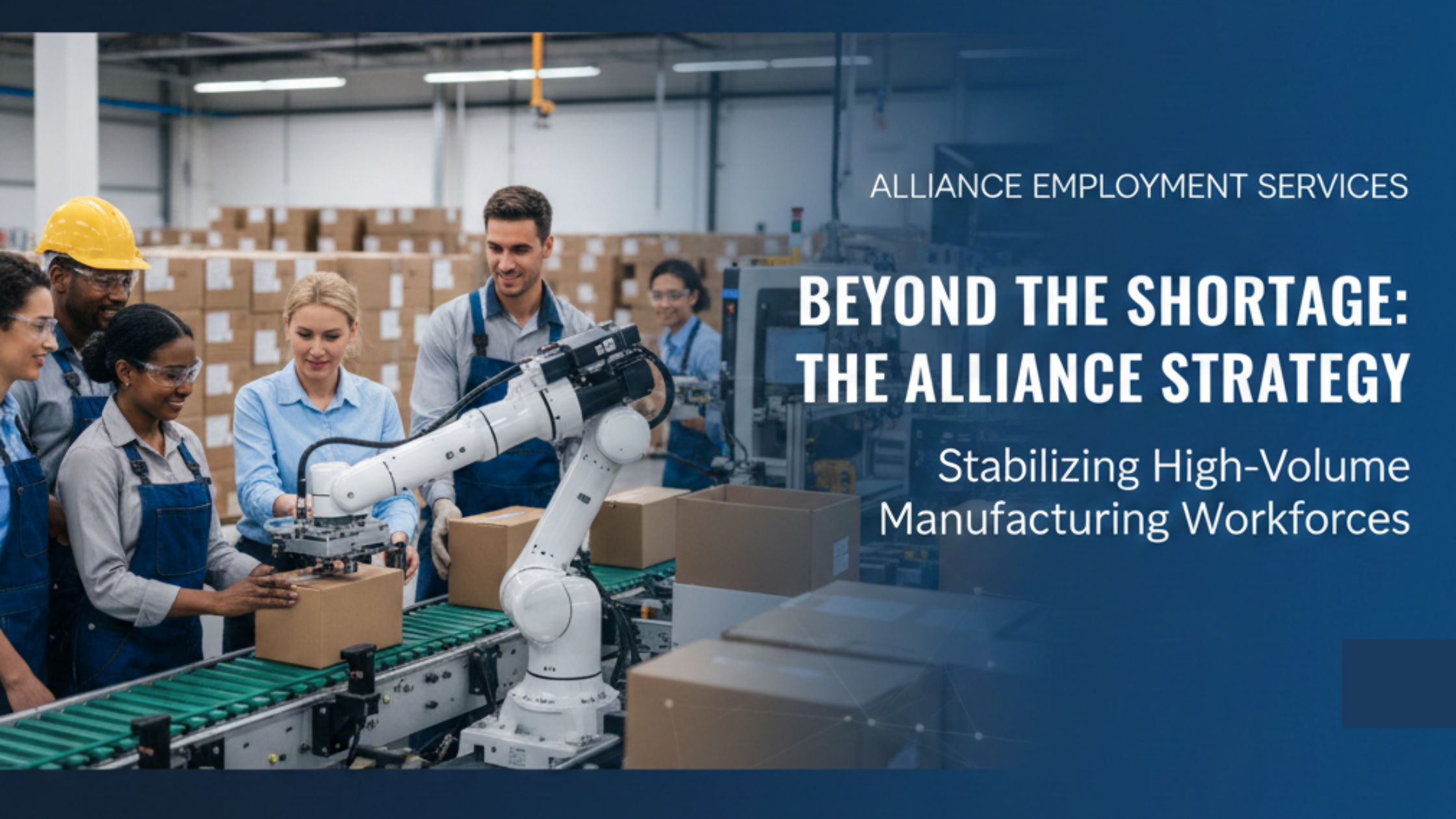
It is easy to look at the current economic climate—defined by tariffs, market volatility, and a general slowdown—and assume that labor is becoming less of a constraint. However, this feeling is misleading. While short-term economic factors fluctuate, the manufacturing industry across Canada and the United States is facing a serious and long-term labor crisis. This is not a temporary hiring slowdown. It is a structural workforce problem driven by an aging workforce, a growing skills gap, and changing worker expectations.
Experts project that by 2030, more than 2.1 million manufacturing jobs are expected to remain unfilled in the United States, with Canada facing similar pressure, especially in major industrial hubs like the Greater Toronto Area. For manufacturers operating in Toronto, Mississauga, Brampton, and Vaughan, this structural labor shortage directly impacts production capacity, delivery timelines, workplace safety, and profitability. Many plants may be running below capacity not because of weak demand, but because they do not have enough skilled workers to keep production lines running.
Traditional hiring methods are no longer effective in this environment. Posting job ads and waiting for qualified candidates is no longer enough. Manufacturers must adopt a workforce strategy that balances immediate production needs with long term labor stability.
Why the Manufacturing Labor Shortage Continues
The manufacturing labor crisis exists because several long-term challenges are happening at the same time.
• A large portion of skilled manufacturing workers are approaching retirement, and there are not enough younger workers entering the trades to replace them.
• Manufacturing roles now require more technical and transferable skills due to automation, yet many available workers do not meet exact job requirements.
• High turnover caused by long hours, rigid schedules, and burnout continues to drain the workforce.
• Manufacturers are competing with logistics, construction, and service industries for the same labor pool.
Together, these challenges create constant understaffing, high overtime costs, production delays, and repeated rehiring cycles.
The Two-Tier Workforce Strategy
The Two-Tier Workforce Strategy is designed to solve both short term and long term labor challenges.
• Tier One focuses on immediate production stabilization by filling labor gaps quickly with qualified manufacturing workers.
• Tier Two focuses on building a long term, resilient workforce by turning temporary labor into a reliable talent pipeline.
This approach allows manufacturers to protect output today while preparing for future workforce needs.
Tier One: Immediate Production Stabilization
When production slows or stops, the priority is to restore output quickly without compromising quality or safety. Tier One focuses on fast, reliable staffing support.
• Alliance Employment Services provides rapid response access to pre screened manufacturing and industrial workers who can be deployed to GTA facilities in as little as three hours. This helps manufacturers manage last minute absences, demand spikes, and seasonal surges.
• Alliance specializes in serving Toronto, Mississauga, Brampton, and Vaughan, allowing for faster response times and more reliable worker attendance.
• Workers are screened for manufacturing experience, equipment exposure, and reliability to reduce training time and production errors.
• Alliance manages payroll, safety documentation, and employment compliance, allowing internal teams to focus on operations and quality control.
Tier Two: Building a Long-Term Workforce
Once production is stabilized, manufacturers must move beyond short term fixes. Tier Two focuses on solving the labor shortage at its core.
• Temporary assignments are used as working interviews, allowing manufacturers to evaluate attendance, performance, and cultural fit before offering permanent roles.
• Workers are hired for attitude and potential, then trained and upskilled to meet specific production needs.
• Cross training creates multi skilled workers who can support multiple lines and shifts, improving flexibility and reducing future labor gaps.
• Retention improves when workers are offered predictable schedules, flexible shifts, and supportive onboarding experiences.
This approach reduces turnover, lowers hiring risk, and builds a stronger internal workforce.
Quality, Safety, and Compliance in Manufacturing Staffing
Speed alone is not enough in manufacturing. In industries such as food production, packaging, automotive supply, and electromechanical manufacturing, quality and safety are critical. Poorly matched workers increase the risk of errors, waste, injuries, and shutdowns.
Alliance Employment addresses this by focusing on precision screening rather than trial and error hiring. Every worker is evaluated for equipment exposure, transferable manufacturing skills, and reliability. Soft skills such as adaptability, teamwork, and attendance history are also assessed. This ensures that workers can integrate smoothly into production lines with minimal supervision.
As a fully licensed staffing agency, Alliance also manages payroll, employment standards compliance, safety documentation, and workforce administration. This removes a major burden from internal HR and operations teams. Manufacturers can focus on production efficiency, quality control, and continuous improvement while Alliance handles the employment responsibilities.
Frequently Asked Questions
Q1: What is the main cause of the labor shortage in high-volume manufacturing?
A: The labor shortage in high-volume manufacturing is primarily caused by a combination of factors: an aging workforce reaching retirement, a significant skills gap where new workers lack technical expertise for modern machinery, and evolving worker expectations regarding flexible scheduling and workplace culture. Experts project that over 2 million manufacturing jobs could remain unfilled in the coming years if these issues are not addressed.
Q2: How fast can Alliance Employment Services provide workers?
A: Alliance Employment Services specializes in rapid response staffing. For contingent labor needs, we can often schedule and deploy staff to your facility in the GTA in as little as three hours from your request, significantly reducing costly production downtime.
Q3: What is "Vetted & Matched Talent" and how does it reduce turnover?
A: "Vetted & Matched Talent" refers to our screening process where candidates are matched by relevant skills and suitability for industrial environments. This careful selection ensures the worker is a good fit for the role and the company, which helps reduce the high turnover rate common in temporary staffing.
Q4: Does Alliance only provide temporary workers, or can they help with permanent hiring?
A: Alliance provides a complete staffing solution, including Temporary, Contract, and Full-Time Hire placements. We often utilize temporary roles as a "working interview" to identify the best candidates for permanent positions, creating a secure, low-risk talent pipeline for our clients.
Q5: What key industries does Alliance Employment Services specialize in within the GTA?
A: Alliance has deep expertise in staffing high-volume facilities across the Greater Toronto Area (GTA), specializing in critical sectors such as Food Production, Automotive Manufacturing, Warehousing & Distribution, Packaging, and Industrial Trades/Labourers.